Tuesday, 9 October 2012
Misplaced - Test Bed
This is a link to a clip from a test film which Rick and I have been developing in anticipation of our real moving image piece on the Thames Estuary. This is my rendering of the footage we shot.
It was filmed at a local site called Bodenham Lake which used to be a working gravel pit until the mid 80's and it is now a nature reserve. There are still remnants of the site such as concrete aprons and slabs and rows of uniform trees, planted to block out the chaos of industry and destruction on this once precious meadow. The River Lugg which runs alongside the land, left handy deposits of gravel in the land and it was originally excavated by hand until it became worked by machinery.It has a kind of faded beauty to it and an oddness. The manmade lake is now like a Karl Stockhausen electronic performance piece with the multiple bird sounds which rise and fall, echoing around the flat spatiality of carved land.
I think Rick summed up very well what our intentions with this particular test film were in the previous entry (26/06/12 - Bodenham Marshes). It was never intended that we come with a tight script, narrative or bunch of ideas that would be self explanatory. We are aiming to approach the final ED film on the Thames Estuary with a sensitivity to the space, trying to work in a more responsive manner, absorbing the nuances and letting the delicate details of the landscape emerge. At the moment it feels like there is an urgency to complete this sooner than rather than later, with the disastrous idea of the area being threatened for the development of an airport. Of course we inevitably bring our own back stories into play, our individual perceptions. It is almost impossible to remove such stains. I think of it rather like the Stan Brakhage films with those translucent marks painted onto the film strip by hand. It's hard to erase such marks.
I'm still thinking of ropes by the way. And drawings....
Link for Stan Brakhage - Dog Man Star
http://youtu.be/mTGdGgQtZic

Tuesday, 11 September 2012
Journeys & Reflections - Jo Roberts and Stephen Turner
I've recently been sent a link to an exciting project in the Medway and Swale areas of North Kent by Urban Fringe which includes the work of Jo Roberts & Stephen Turner. I've long been an admirer of Stephen's work and followed his interactions with the landscape and area around the Medway over a number of years. This is the first time I have encountered Jo's work and I love the idea of hers to explore the perceptions of boundaries through the local community which she has then mapped. It is interesting to note that Jo studied Geography before developing her creative practice.
Stephen has been amongst other things, distilling plants and created an essence; Eau du Bordure. I love the twist in exploring what some may consider wasteland, spaces which render little value and then extracting out of it, something of wonder. Well i haven't sampled the essence yet but I bet it is delightful.
http://urbanfringes.wordpress.com/exhibition-events/
http://urbanfringes.files.wordpress.com/2012/09/stephen-jo-at-milton-creek-lr.jpg
Stephen Turner and Jo Roberts present Journeys and Reflections around the edges of Medway and Swale; a multi media exhibition of drawing, maps, photography, video and pressed flowers, as well as distilled plants oils and papers made from local flora. The exhibition will include an Urban Fringe Library, contained in a small leather suitcase.
Tuesday, 26 June 2012
Bodenham Marshes Film - beginning a moving image aesthetic conversation'
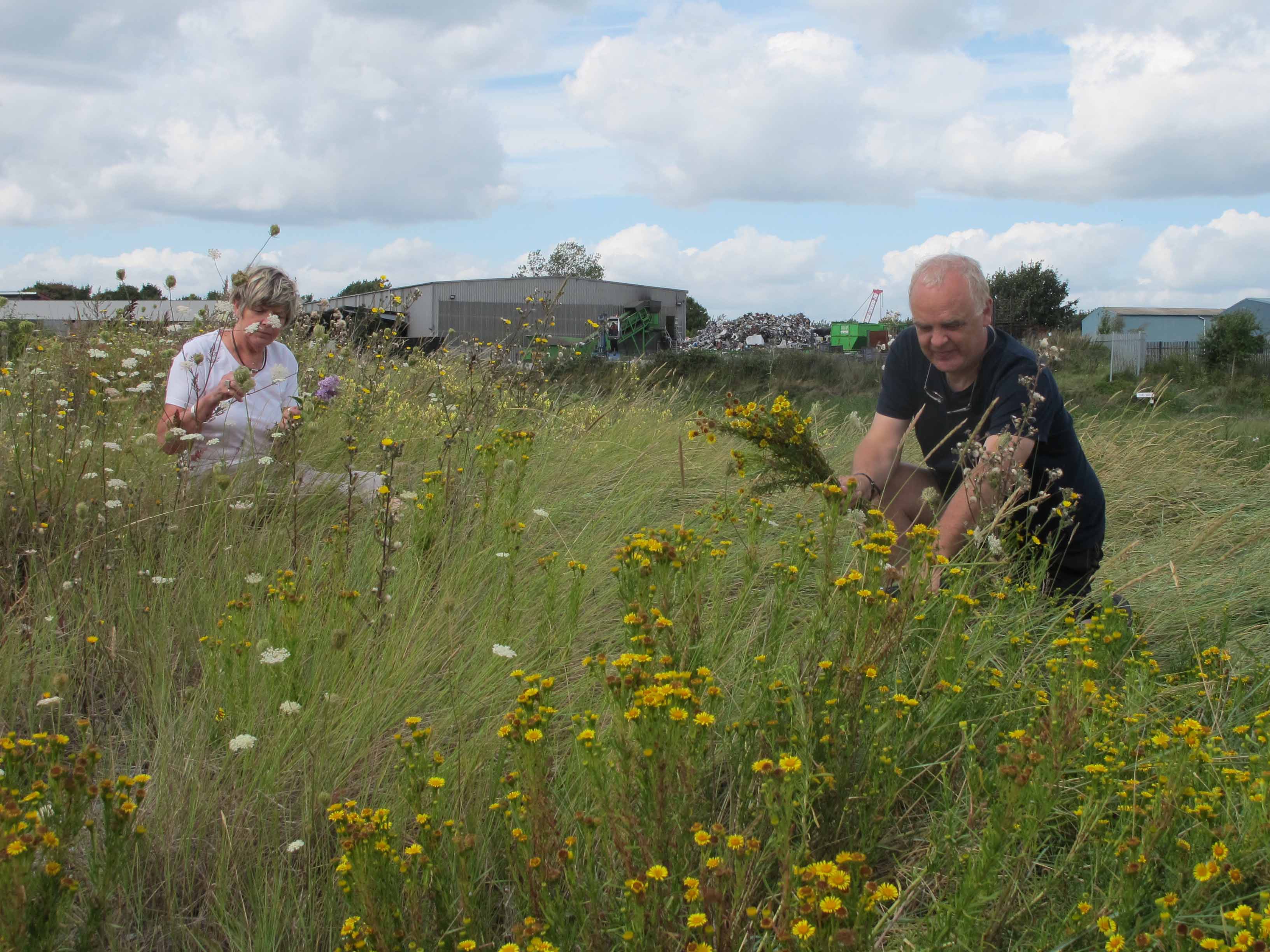
Anna and I decided to visit Bodenham Marshes last Saturday. We had planned to try a few ideas for the ED film. Before going down to the site I spent some time looking at my own poetics and texts that I feel are linked to the work. Much of this is site specific or landscape-based.
In terms of my normal film-making practice this 'shoot' was very differently approached in terms of pre-planning. There was no storyboard or script. No treatment. I had only have a very abstract sense of what we were going to do on the day - which was exciting. I was thinking of certain structural modes of working e.g. using fixed lengths of camera movements in different directions, and also ways of mapping a space visually, but beyond that i was keen to let alot of the thinking work to be done by my 'back-brain' unconsciousness.
We knew we wanted to try out some techniques e.g. tracking and particular hand-held shots - but beyond that little else was decided. We did try some tracking with a dolly which a local film-making friend, Neil Oseman had lent me. But these didn't really work out - we wanted a very slow and very smooth movement that we couldn't really pull off to our satisfaction. We'll probably use some Hollywood Dolly tracks and dolly from a B'ham based company.
I did have one recurring approach that I wanted to try though - that of the camera hovering close to a figure as the figure explores an environment and bring it vividly to life. On the day this really became an interesting point of departure for both Anna and I. We tried this many times, using different Olympus prime lenses on my Panasonic AG-AF101 camera. It worked best when the camera hovered close to the figure - without revealing the face - it brought up alot of questions and interesting lines of enquiry, which I intend to investigate further.
I wanted to respond quite rawly to the place, and also leave an openness so that Anna and I could truly create an 'a moving image aesthetic conversation' at the site. Of course this could prove quite a dangerous thing to do, but this became a positive.
Later, looked at the footage from Saturday and really, really liked some of it - there were a few shots that I found very effecting - and I started to look forward to begin editing it. I have a poem which began speaking with the imagery, which was weird as I was hoping to record it on the day.
The early filming was very much spoilt by the tracks not doing what we wanted but it's helpful to look at the footage as it gave me some ideas of what we could achieve. A wide shot of the the landscape was particularly good. The main revelation was the footage of you walking through the landscape and then to the lake. Some of the shots really began suggesting some possibilities.
Anna and I both now intend to work on the footage from the day's filming seperately.
Rick
Friday, 8 June 2012
Incarcerated

 I've been focusing on preparations for a funding bid for Estuary Dialogues recently so my drawings and other practical work have taken a bit of a back seat. Going back into my studio last week, I was playing around with some ideas when I picked up a box of these small clear bottles with stoppers, that I had ordered from a company who make containers for collecting insect specimens for my last project, Adventureland.
There is something about the scale of these bottles that I liked so I thought about using them in the ED project. On a very thin strip of tracing paper I began to draw a reductive version of a prison hulk. These hulks were originally naval ships but were decommissioned and used to house prisoners offshore in the 1700's to late 1800's. Conditions onboard were grim according to records in the National Maritime Museum, Greenwich and the Guildhall Museum in Rochester. Prisoners were poorly fed and clothed, had to do long days labouring shackled together and disease was rife. Often prisoners were sent to America and then Australia as convicts.
I wanted to draw these hulks on a tiny scale, with fragility and attention to detail which was quite challenging. I then put them inside the bottles reminiscent of old ships in bottles. I like the fact that the drawings become incarcerated; both a nod to the historic version of events but also a reversal of events. Instead of being the prison, the hulks have now become the imprisoned.
I've been focusing on preparations for a funding bid for Estuary Dialogues recently so my drawings and other practical work have taken a bit of a back seat. Going back into my studio last week, I was playing around with some ideas when I picked up a box of these small clear bottles with stoppers, that I had ordered from a company who make containers for collecting insect specimens for my last project, Adventureland.
There is something about the scale of these bottles that I liked so I thought about using them in the ED project. On a very thin strip of tracing paper I began to draw a reductive version of a prison hulk. These hulks were originally naval ships but were decommissioned and used to house prisoners offshore in the 1700's to late 1800's. Conditions onboard were grim according to records in the National Maritime Museum, Greenwich and the Guildhall Museum in Rochester. Prisoners were poorly fed and clothed, had to do long days labouring shackled together and disease was rife. Often prisoners were sent to America and then Australia as convicts.
I wanted to draw these hulks on a tiny scale, with fragility and attention to detail which was quite challenging. I then put them inside the bottles reminiscent of old ships in bottles. I like the fact that the drawings become incarcerated; both a nod to the historic version of events but also a reversal of events. Instead of being the prison, the hulks have now become the imprisoned.
Friday, 18 May 2012
Momentary Presence/Absence (sooty shadows)
I photographed the lengths of rope on Wednesday in a studio setting. This was a much more orchestrated process compared to the scanning of the ropes, which I have been doing recently. Setting up the ropes was much more tricky than I thought mainly because I wanted to suspend them and be able to get the whole length of the rope in. I selected a grey backdrop which softened the coarse nylon orange rope. The rope lengths were surprisingly heavy, even small pieces. Initial experiments involving a line of fishing wire going across the studio where I tied the rope on, failed. The weight of the rope pulled the wire down and the rope was only partially suspended. I then noticed two metal eyes, in the ceiling and they were positioned in a good enough place where we could tie the rope. Brilliant! The ever patient Cai, who was the studio technician, threaded fishing wire through the eyes and then attached two pieces of rope. Cai then helped me set up the right lighting and finally I could begin photographing the ropes.
Once the ropes were suspended they looked magical, as though they were on a stage for a performance. I mused on their life, thinking about where they had been before I picked them up from the shoreline in Kent. It was interesting to think that they had been discarded, lying flaccid on the shore. Suspended they appeared majestic.
I selected two very different lengths of rope, one long piece that was tight and neat at one end with a small bristle of fibres at the other. The other was less tightly bound and each end had unwound into unruly sections. As they were suspended their forms unfolded.
I began photographing them and fixed on the rope to begin with. I worked from distance then close up. I moved the light source around. As I did this I noticed the shadows from the ropes altered, either virtually disappearing or suddenly emerging soot black. The camera began documenting these momentary impressions which were like drawings of the softest charcoal on the grey paper. I found them mesmerising and seductive. Somehow the shadows dominated the stage and as quickly as they were created, with the touch of the lamp's off switch, they evaporated.


Thursday, 10 May 2012
A grain of sand in the hem of Madame Bovary's winter gown *
* Sebald, W.G., The Rings of Saturn, 2002; Vintage (London). (P8)
I have begun to read W.G. Sebald's book, The Rings of Saturn. It is a record of a coastal walk through East Anglia by Sebald that prompts reflections on past cultures and people. I really like the way it meanders down metaphorical pathways and places which seem on the periphery. It feels both lucid and eccentric in its subject matter.
The quote which is the title of this post, just seemed so complete and beautiful to me. In the book it explains that Flaubert who wrote Madame Bovary, saw the whole of the Sahara in this grain of sand in her gown.'For him, every speck of dust weighed as heavy as the Atlas Mountains.'I love the significance and weight given to that one grain; how potent it becomes. It has made an interesting connection for me with the work I am doing with the ropes. I took them last week and began scanning them on a large scanner. The aim was to achieve a similar image as before but with a better quality finish. As the process was happening, I noticed how beautiful the motion of the light passing underneath was. There were reduced beams of light that momentarily flickered as the rope was scanned. It created a shadow on the white lid of the scanner; a ghostly imprint.
I videoed this action with my iphone which has not come out brilliantly but it is like a sketch. Tomorrow, I can hopefully continue this process using a better camera and give it more time.
Friday, 27 April 2012
Humbrol Enamel Paint
It's been a strange period in the project. The momentum from the drawings has dissipated and other elements have been crowding into my vision, such as the ropes or other responses to my site visit in February. Plus I have been weathering a virus on and off for some weeks so it has all really disrupted my flow which is frustrating. I do always try and stay philosophical though because sometimes these blips in progression are quite useful (in hindsight). It can allow one to re-focus, re-analyse the ideas and work. I do find myself getting rather desperate during these periods and despondency creeps in. Every action feels so exposed as you think 'is this it, am I on the right track now or going into cul-de-sac?'. No matter if I go through this cycle a thousand or more times, I panic, then I relax and its all ok until the next big wave.
During this period of flux, I had an urge to go to a model shop in Hereford and buy some Humbrol Enamel paints. I've always liked these pots of paint especially the drab colours which they usually come in. My brother used to make airfix kits and there was always the painting of these models with the appropriate shade of Humbrol. It was an activity that I was definitely excluded from, being the in the 1970's. So I probably harboured ambitions to use Humbrol paints for sometime. It still feels like a very masculine environment in the model shop. I like the size of these Liliputian paint pots. Obviously Humbrol are making good money out of these but I love the fact that the paint is doled out in small amounts.
I started to use the paint on blanking out areas of hand drawn maps on tracing paper that I was working on. I like the way the paint sits on the surface of the paper, all glossy and opaque. I then looked at the details and symbols on the OS maps which indicate things like caravan sites or youth hostels. I have been taking some of these symbols and hand drawing them onto graph paper in multiples. Using the Humbrol enamel paints, I have hand coloured these symbols, so i ended up with 168 camping sites or 224 beacons. I also looked at the details often drawn on coastal maps such as shingle or mudbanks and then translated these onto the graph paper. I enjoy the repetition of drawing these symbols yet they are never exactly the same and you can see each symbol has a different quality.
Taking these drawings on graph paper, I began playing with light and shining a strong light source through the paper which makes the graphic qualities of the paper, luminous. Where the Humbrol paint sits, it remains opaque and solid, the symbols almost floating. I started to layer these drawings up so I had one with Beacons on in an orange colour behind another with grey campsites. I inevitably seem to come back to wanting to find the latent in my work. It's always the unexpected in my work which fascinates me.


Subscribe to:
Posts (Atom)